
If you are starting an e‑commerce business in 2026, you do not need more random tips. You need a system you can actually follow. A way to go from “I have no idea what I am doing” to an online store that is set up to make money.
Most beginners fail at e‑commerce not because it does not work, but because they focus on the wrong things in the wrong order. They obsess over logos, colors, and animations while ignoring fundamentals like market research, customer acquisition cost, and basic store math.
Meanwhile, the most successful online stores keep things much simpler. They have a clear offer, a clean e‑commerce website, a straightforward marketing strategy, and a tight handle on key performance indicators like conversion rate, average order value, and customer lifetime value.
This 6-step blueprint breaks e‑commerce down into four core pillars: platform, offer, traffic, and numbers, plus one long-term growth layer (SEO).
1. Choose the Right Platform
Your e‑commerce platform is the foundation of your store, but it is also where beginners waste the most time. They bounce between tools, compare every technical feature, and delay launch for months. In reality, your chosen business model and operations plan matter more than obsessing over software.
For most beginners, a hosted e‑commerce platform like Shopify is enough. It gives you secure payments, mobile responsiveness, checkout functionality, basic inventory management, and integrations with analytics and marketing tools. That means you can focus on product descriptions, pricing strategy, customer experience, and your business plan, instead of wrestling with code or complex technical aspects.
At this stage, your only job is to get a simple, functional e‑commerce store live. Clean product pages, clear pricing, and a smooth checkout beat a perfect design that never launches.
2. Build a Strong Offer
The biggest misunderstanding in e‑commerce is thinking the product itself is the offer. It is not. Your offer is the product plus the price, positioning, promise, and everything else that makes it easy for your target audience to say yes.
Two stores can sell the same physical product, for example, a private label brand and a generic competitor in the same digital marketplace, and still get completely different results. The difference is how well they understand their target market and how clearly they communicate value. Strong offers are built on real niche validation and market research. You know what problem you solve, why your solution is different, and how it fits your target audience’s needs and budget. Studies on small and medium e‑commerce websites have found that clear value and promotion strategies are key determinants of higher conversion rates.
Practical offer levers include:
- Bundling complementary products to lift average order value
- Guarantees and returns policies that reduce risk
- Clear positioning, detailed buyer personas, and messaging that speaks to customer pain points
You cannot outspend or out-advertise a weak offer. Paid ads, social media marketing, and clever e‑commerce tools will not fix something people do not want or do not see as worth the price.
3. Design a Store That Makes Buying Easy
Many new e‑commerce entrepreneurs accidentally hurt their own sales with over-designed stores. They add pop-ups, sliders, banners, and endless sections. When a visitor lands, there is no clear path.
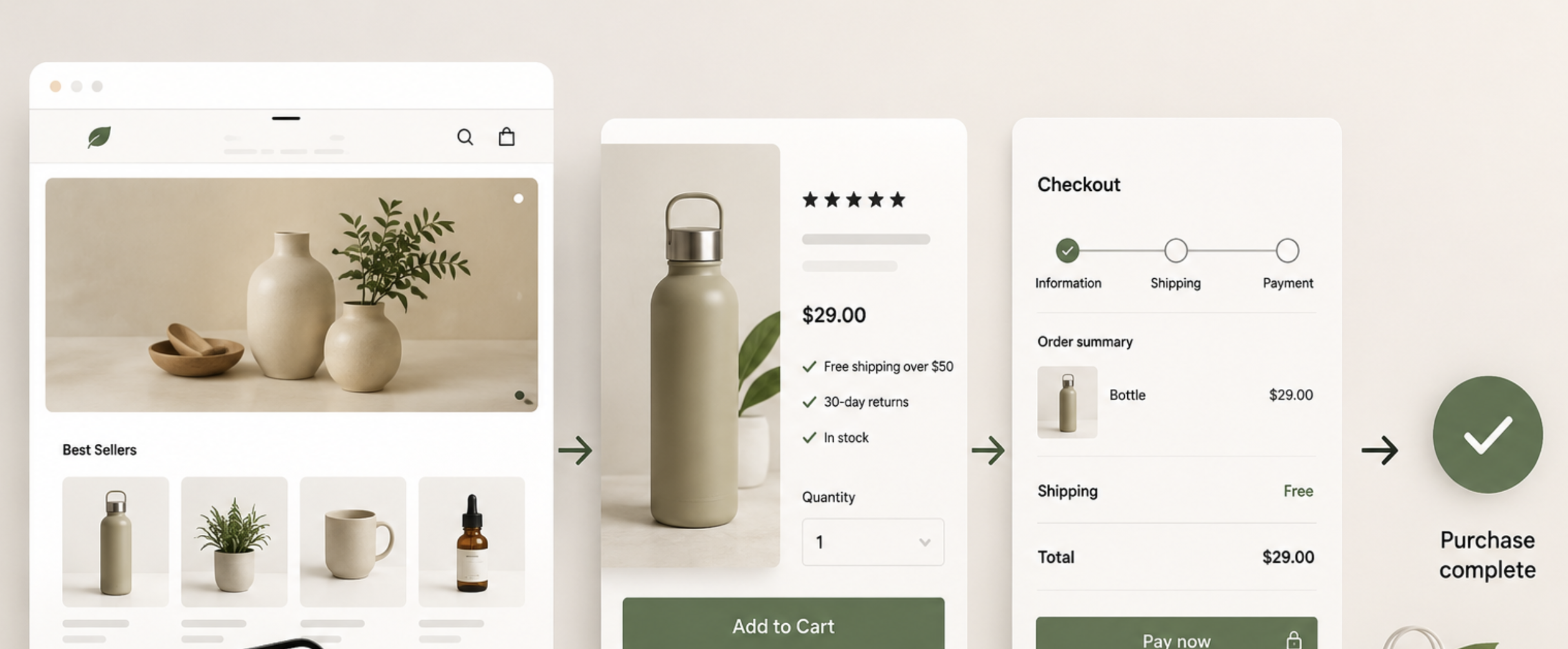
A high-converting e‑commerce website is usually simple. It has a clear headline that states what you sell and who it is for, an obvious primary product or collection, transparent pricing and shipping costs, and a prominent Add to Cart button that leads to a short, logical checkout. Mobile responsiveness matters as well, because a large share of user behaviour now happens on mobile devices. Studies based on millions of orders show that extra checkout steps, forced account creation, and surprise shipping fees are some of the most common friction points and directly reduce completion rates.
Your goal is not to impress people with design. It is to guide them from click to purchase with as little confusion as possible.
4. Use Ads to Validate, Then Scale
Many beginners start with search engine optimization or organic social media, but those are usually the slowest ways to validate a new e‑commerce store. Paid ads give fast feedback on your offer, pricing strategy, and messaging.
There are two main lanes. Search intent traffic, like Google Ads, reaches people already looking for what you sell and is one of the most direct ways to validate demand. Interruption traffic, like Meta ads on Facebook and Instagram, reaches people who are scrolling, so your creative must grab attention and create interest.
Early on, the real purpose of paid advertising is to get data, not to get rich. You want to know if people click, add to cart, and buy, and at what customer acquisition cost your e‑commerce business can actually work.
5. Know Your Numbers
Knowing your numbers is what keeps you from scaling a losing store. The key performance indicators that really matter are tied to your business model and cash flow. These include customer acquisition cost, average order value, contribution margin, and customer lifetime value.
A core advertising metric is ROAS, return on ad spend. It tells you how much revenue you generate for every dollar of ad spend. However, ROAS alone does not equal profit. From that revenue, you still have to subtract product costs, shipping costs, payment fees, software subscriptions, and any other operating expenses. Every store has a break-even ROAS where you are not losing money but not really growing either. Above that, you have room to reinvest and scale. Below that, the business is quietly losing money.
Analytics tools, for example, Google Analytics and built-in reporting from your e‑commerce platform, help you track user behaviour and KPIs across your e‑commerce website. You can see where visitors land, where they drop off, which products convert, and which campaigns actually bring in profitable customers. That data guides decisions on pricing, sales strategy, creative, and even stock levels and inventory management.
When you know your numbers, you stop guessing. You can decide confidently whether to push ads harder, refine your offer, change your pricing, or improve the site experience.

6. Layer in SEO for Long-Term Growth
Search engine optimization is a powerful way to drive traffic, but it works best after you have already validated your offer and numbers with faster channels like paid ads. If you rely on SEO from day one, you are guessing which pages convert, which keywords matter, and how your target audience actually searches.
Once your store is converting, SEO becomes a long-term growth channel. You can do keyword research, use tools like Google Trends to understand demand, and create content around proven products and real customer questions. You then optimize product and category pages that already perform and improve internal linking and site structure to support better rankings.
Over time, this organic traffic lowers your blended customer acquisition cost, improves customer lifetime value, and makes your business less dependent on paid ads. E‑commerce in 2026 is not about chasing every new hack. It is about getting a simple system right, then using SEO and other channels to deepen that success
Need Help With Your E-Commerce Store?
Get in touch with Search Pros today to turn your e‑commerce idea into a store that is built on the right foundation from day one.