
Every successful e-commerce business runs on the same invisible system.
The problem is, most people running an e-commerce store never fully understand how that system works until it is too late.
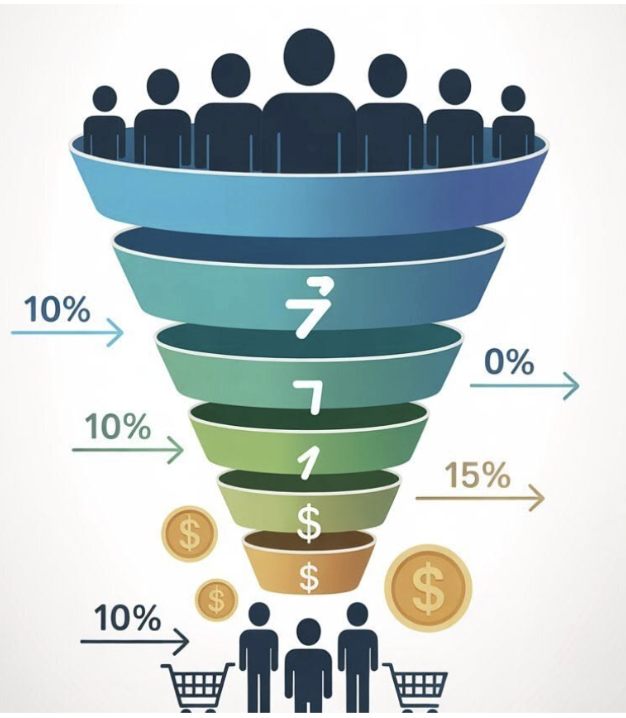
The E-Commerce Profit Funnel
Every e-commerce business, whether you sell pet food, coffee mugs, digital goods, or your own products on your own e-commerce site, runs on the same four-part funnel:
- Traffic: paid or organic visitors landing on your e-commerce website
- Revenue: the percentage of those visitors who purchase products
- Expenses: the costs attached to fulfilling every order
- Profit: what remains after everything else
That is the entire process. One e-commerce model. And every part of it affects everything else.
If traffic costs rise, your revenue model shifts. If conversion drops by even one percent, profits can vanish overnight. If margins are thinner than you think, your online business can look profitable and still be losing money.
Paid Traffic and Customer Acquisition Cost
At the top of every e-commerce store is a simple question:
How do you get potential customers to your digital storefront?
Most e-commerce entrepreneurs turn to Google Ads or Meta Ads to drive visitors. But here is the key insight most people miss: traffic is not the goal. Profitable traffic is the goal.
Every visitor costs money. If you are running paid ads, you are often paying per click, maybe $1, maybe $5. But the number that actually matters is your Customer Acquisition Cost (CAC): how much you spend in total to win one paying customer.
If it takes 100 clicks at $2 each to generate one sale, your CAC is $200. If your average order value is $100, you are not running a business. You are losing $100 every time someone buys from you. New customers are only valuable when the math supports acquiring them.
Conversion Rate: The Multiplier That Changes Everything
Once someone clicks through to your e-commerce site, the conversion rate determines whether that traffic becomes revenue or wasted spend.
At a 1% conversion rate, 100 visitors produce one customer. Improve that to 2%, and you have cut your CAC in half without changing a single ad. Same traffic. Same spend. Twice the efficiency.
According to Adobe the average e-commerce conversion rate is 3.65%. This means that nearly 4 out of every 100 site visitors are taking a desired action on e-commerce websites.
This is why your product pages, your offer clarity, and a user-friendly checkout experience matter so much. These are levers you control directly. Unlike bidding on search engine results pages or competing for placement across online marketplaces, your own store is yours to optimize. Small improvements to the customer journey compound across your entire funnel and directly reduce what it costs to sell goods at scale.
Average Order Value: More Revenue from Every Customer
Conversion rate tells you how many customers you get. Average Order Value (AOV) tells you how much each customer is worth.
Combine the two, and you can calculate exactly how much revenue your ecommerce store generates per visitor. If 2 out of every 100 visitors buy, and each order averages $100, you are making $200 per 100 visitors. That single number tells you whether your online sales channels are working.
Bundling complementary products, adding upsells at checkout, and setting free shipping thresholds are all strategies designed to lift AOV. Turning a $50 order into a $100 order does not require more traffic or a bigger marketing budget. It just means your existing funnel becomes more profitable instantly. This is one of the most practical and underused levers available to e-commerce entrepreneurs operating across multiple channels.
Margin: Where Real Profit Is Decided
Revenue is not profit. This is the lesson that breaks most e-commerce businesses.
After product cost, shipping, payment processing fees, and returns, a $100 order might only leave $30 to $40 in your pocket. According to Forbes Advisor, e-commerce profit margins typically range from 10% to 20%. That remainder, your contribution margin, is the number that actually determines whether your business model is viable.
Many e-commerce store owners operate on what could be called fake margins. They look at product cost and ignore everything else, whether they are running a private label brand, white labeling a generic product, selling their own brand, or drop shipping from other businesses. They assume a 50% margin when the real figure, after fees and fulfillment, is closer to 20%.
That one mistake changes everything: how much you can spend acquiring customers, how aggressive you can be with ads, and whether scaling will grow your profits or multiply your losses. Healthy profit margins require knowing every cost in your tech stack and supply chain, from inventory management to payment processing to returns handling.
If you do not know your real margin, you do not know your business.

ROAS vs. Profit: The Misunderstanding That Sinks Stores
Once you are running paid campaigns, one number tends to dominate the conversation: Return on Ad Spend (ROAS). And this is where a lot of online businesses get completely misled.
ROAS is a revenue metric. It is not a profit metric. A 3x ROAS means that for every $1 spent on ads, $3 comes back in revenue. That sounds strong. But if your margin is 30%, that $3 only returns $0.90 in actual profit, and you just spent $1 to get it. You lost money on every single sale while your dashboard looked perfectly healthy.
This is how e-commerce stores scale to the ground.
They see a good ROAS on their Shopify stores or across their online sales channels and assume things are working. But if margins do not support that return, every new customer is a net loss.
The better question to ask is not “what is my ROAS?” It is “what ROAS do I need to break even, and what do I need to actually profit?” That number comes entirely from your margin. Higher margins give you room to acquire customers at a lower return. Thin margins mean you need a significantly higher ROAS just to stay alive.
E-Commerce as an Investment Engine
Once you understand this system, e-commerce starts to look very different from other ways of making money online.
Most investments, whether stocks, real estate, or other assets, ask you to put money in and hope the market moves in your favor. You are along for the ride. E-commerce, when operated properly, is different. You have a system you can actually control.
You can improve your conversion rate through better product pages and a smoother customer journey. You can raise AOV through smarter bundling and upsells. You can lower CAC through keyword research, search engine optimization, and stronger email marketing to existing customers. You can protect margin through better inventory management and supplier relationships.
Every one of those improvements directly increases your return. Instead of guessing, you are engineering outcomes. And when that system works, it can outperform almost any other online business model because you are consistently investing $1 and getting $2, $3, or more back.
Bringing It All Together
The e-commerce businesses that win are not the ones with the most traffic or the biggest ad budgets. They are the ones who understand their numbers and make them work together.
- Know what it costs to acquire new customers across every channel
- Know your real conversion rate on your e-commerce site
- Know your true average order value, not just your best days
- Know your actual margin after every fee, every return, every cost
Whether you are managing a small business selling digital goods, building a private label brand, running a business-to-business operation, or growing a storefront that competes with brick-and-mortar stores, the math is the same. Traffic flows in, revenue is generated, expenses are subtracted, and profit is what remains.
At Search Pros, we understand that the businesses that win are the ones that think like operators, not just marketers. We build loyal customers, a strong brand identity, and a competitive edge that compounds over time. That is how e-commerce actually makes money.
Get in touch to discuss your e-commerce goals and turn more traffic into profit.